LUXONNIC


Forming intelligence with light, and using it to clean up the optical signals that move data inside AI data centers, that is the idea behind new xG-portfolio team LUXONNIC.
The Problem
As AI scales, its data centers are hitting a power wall in the optical transceivers that move data across the data center. These draw roughly 40 MW in a single AI data center (a small city's worth of electricity) just to keep data moving internally.
A big chunk of that goes to one component, the DSP chip, which cleans up the optical signal after it gets distorted in transit. The cleanup works, but it happens in electronics, and electronics is where the power goes. And you can't simply remove it: today's approaches force a trade-off between power consumption, bandwidth, and reach, where every option gives you two and costs you the third.
The Solution
LUXONNIC breaks that trade-off by doing the cleanup in light instead of electronics. Their LUXONNICore is a photonic chip that repairs the distorted signal optically. You can think of it as a neural network built from optics rather than transistors. The same clean signal comes out the other side, at a fraction of the power, without giving up bandwidth or reach. It's designed to drop into next-gen transceivers as the component that quietly does the hard part – the secret sauce.
The insight is that the building blocks of a neural network, such as matrix multiplication, nonlinear activation, and recurrent operations, can all be carried out in the optical domain.
In other words, by moving the signal processing into the optical domain, LUXONNICore keeps the intelligence of a full DSP without its energy cost.
This enables:
Power-efficient optical transceivers for AI data centers
High-bandwidth links that keep their reach
A path past the power/bandwidth/reach trade-off baked into today's transceivers
Scaling data-center networks without scaling the power bill
The Team
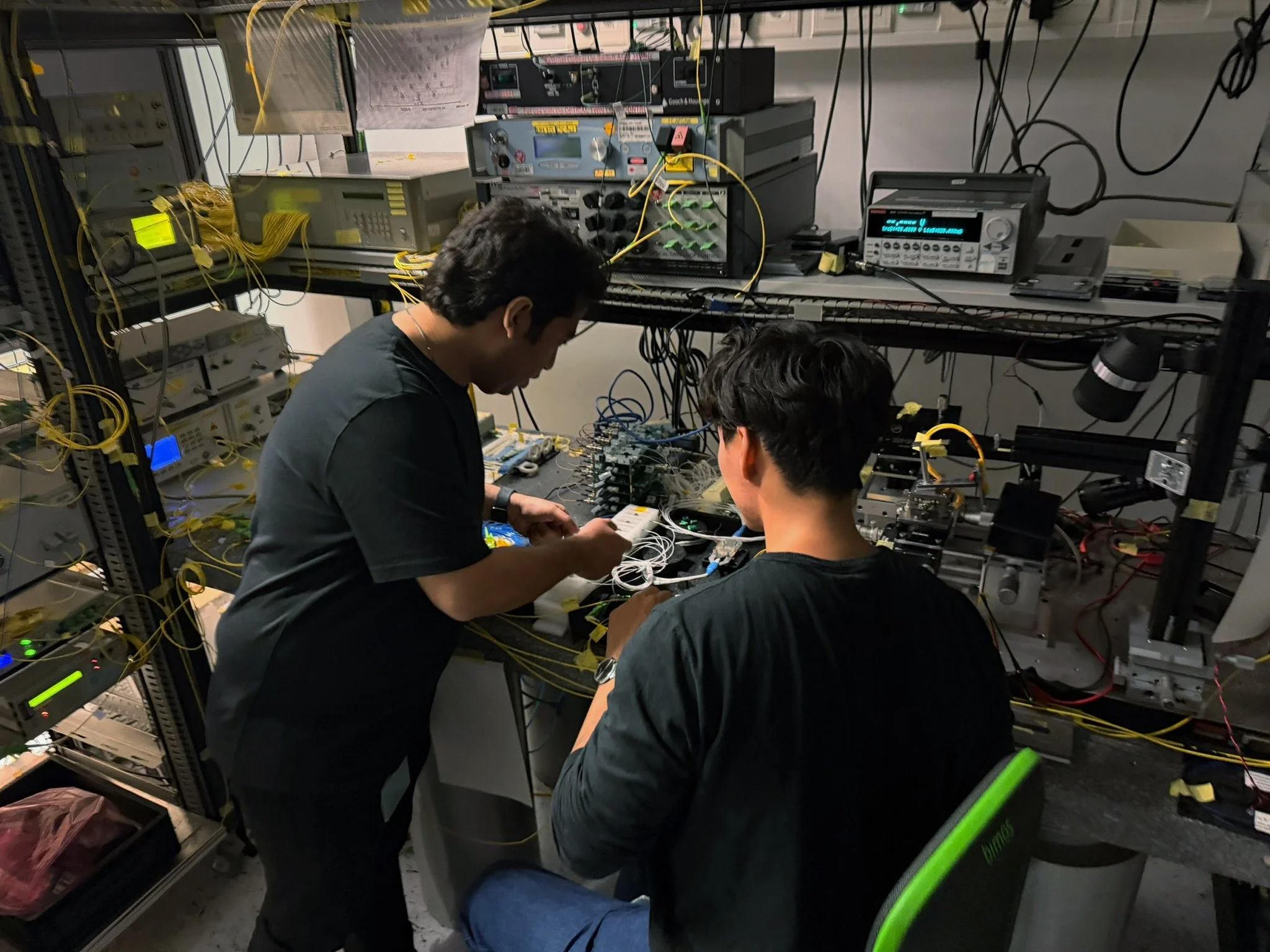
Behind LUXONNIC is a team out of Fraunhofer Heinrich-Hertz-Institut. Co-founder Mahdi Kaveh has 9+ years of professional experience in telecom, including optical neural network work at HHI. Co-founder In-Ho Baek has 5+ years professional experience in pioneering DSP for high-speed coherent optical and next-gen wireless systems. They're advised by Dr. Colja Schubert, who brings 25+ years of experience in optical communication.
We're excited to welcome LUXONNIC to the xG-portfolio and look forward to supporting the team as they work to form intelligence with light.